
Portsmouth mansafe roof safety: A Comprehensive Guide
Maintaining commercial properties along the South Coast presents a unique set of challenges for facilities managers, landlords, and business owners. When it comes to managing height risks on commercial buildings, industrial units, and dockland facilities, implementing reliable Portsmouth mansafe roof safety infrastructure is an absolute necessity. The coastal environment introduces aggressive weather patterns, high winds, and salt-laden air, all of which accelerate the wear and tear on building fabrics and rooftop equipment. Consequently, any fall protection system installed in this region must not only be legally compliant but also robust enough to survive these demanding environmental conditions.
The legal framework governing work at height in the United Kingdom makes no exceptions for geographic location or building age. If an operative is required to step onto a roof to service an air conditioning unit, repair a leak, or inspect telecommunications equipment, the property manager must provide a verified safe environment. Utilising specialised cable-based lifelines, anchorage points, and collective barriers forms the backbone of a modern height safety strategy. By focusing on high-quality Portsmouth mansafe roof safety solutions, local businesses can ensure that contractors can carry out essential maintenance work with the confidence that they are protected by equipment engineered to the highest industry standards.
In this comprehensive guide, we will examine the technical realities of managing fall protection systems in a coastal environment, the legal obligations under UK safety law, and the critical processes involved in local system specification, installation, and ongoing maintenance.
Navigating Coastal Challenges for Roof Safety Equipment
Selecting materials for fall protection in a maritime city like Portsmouth requires a deep understanding of metallurgy and environmental degradation. Standard steel components that might last for decades inland can quickly degrade when exposed to constant salt spray and high humidity. For this reason, professional Portsmouth mansafe roof safety systems rely heavily on Grade 316 stainless steel or heavy-duty hot-dip galvanised finishes. These premium materials provide the necessary resistance to pitting and crevice corrosion, ensuring that the internal structural integrity of the safety wire or anchor post is not compromised by hidden rusting over time.
Wind loading is another critical factor that local system designers must take into account during the structural calculations. Buildings located near the harbour, commercial ports, or seafront areas are subjected to significantly higher wind speeds than inland properties. Freestanding guardrail systems or counterbalanced cable anchors must be calculated with these elevated wind forces in mind. A professional installation team will carefully adjust the spacing of the base weights or structural fixings to prevent the safety system from shifting or lifting during severe coastal storms, providing a reliable and stable safety perimeter under all conditions.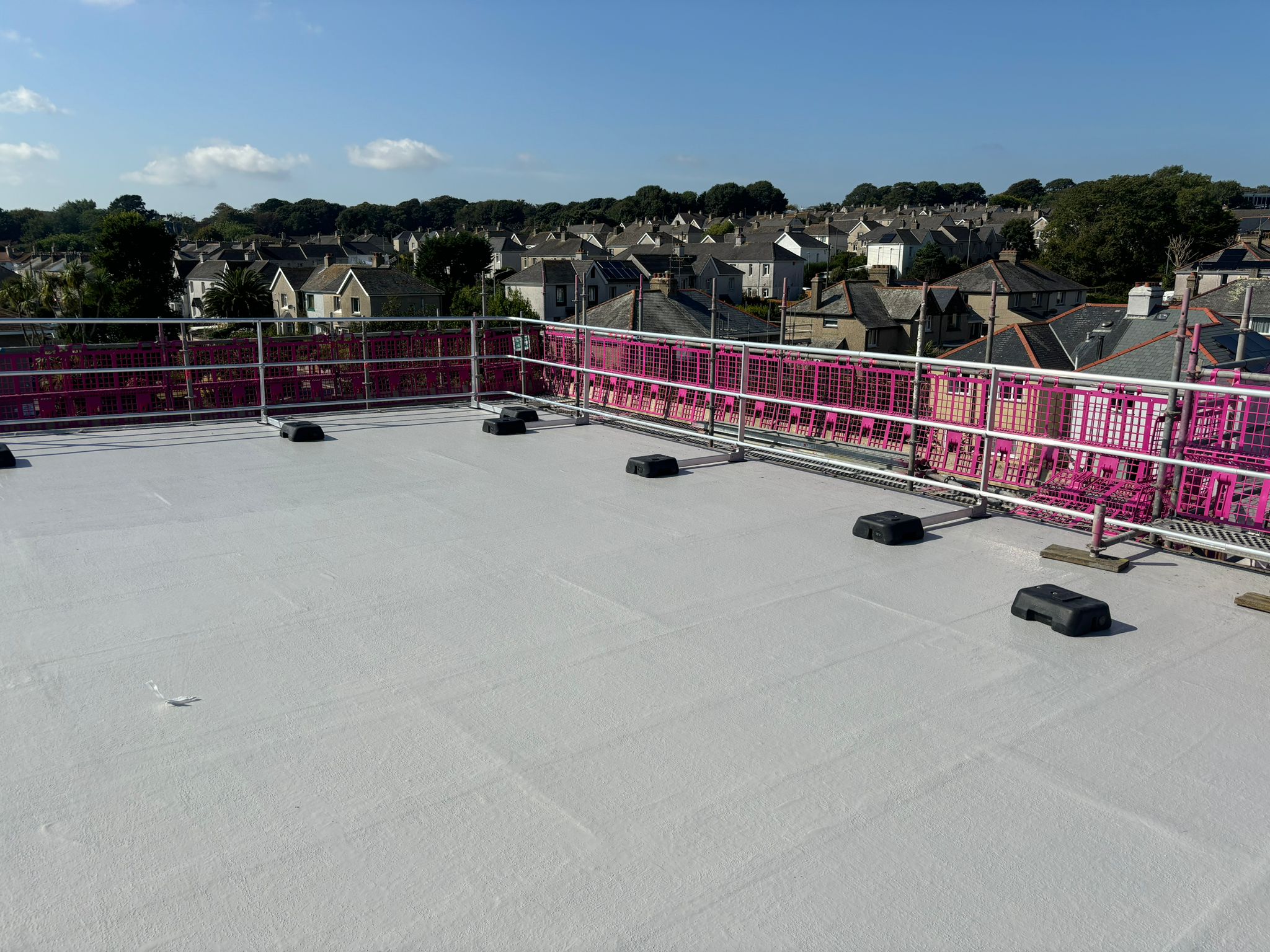
Furthermore, the variety of roof constructions found across the local commercial sector requires a highly adaptable approach to safety design. Historic dockland structures with older timber or steel frameworks sit alongside modern retail parks utilising composite metal panels. Implementing effective Portsmouth mansafe roof safety measures means engineering bespoke brackets and toggle fixings that distribute the dynamic load of a fall safely into the building’s primary structure without causing deformation or tearing to the existing roof sheets.
Legislation and the Strict Reality of Health and Safety Enforcement
All work carried out on elevated surfaces in the UK must adhere strictly to the Work at Height Regulations 2005. The Health and Safety Executive (HSE) actively monitors commercial operations and construction sites across the South Coast to enforce these rules. If a business fails to provide appropriate, certified safety measures, they face the immediate risk of Prohibition Notices, heavy financial penalties, and criminal prosecution. Investing in accredited Portsmouth mansafe roof safety systems is the most effective method for local duty holders to demonstrate that they have executed their statutory duty of care.
The regulations outline a clear hierarchy of control that prioritises collective protection over personal fall protection. However, where architectural limitations or low-frequency access makes a continuous guardrail impractical, an active system like a horizontal mansafe lifeline is the standard choice. These systems can be configured for either fall restraint or fall arrest. A fall restraint setup uses a restricted lanyard length to physically prevent a worker from reaching a hazardous edge or a fragile roof light, eliminating the possibility of a fall occurring in the first place.
When a fall arrest system is unavoidable due to the nature of the work, the entire safety infrastructure must be capable of absorbing the immense shock loads generated when a body is caught mid-air. In these scenarios, the system must incorporate inline energy absorbers to protect both the worker and the roof deck. Property managers must recognise that having a piece of wire installed on a roof does not equal safety; it is the correct configuration, user training, and legal certification of that Portsmouth mansafe roof safety equipment that ensures true legal compliance and life preservation.
Technical Components of a Total Fall Protection System
A standard mansafe setup consists of several highly engineered components working in unison to provide a continuous pathway of safety across a roof surface. The primary element is the high-tensile stainless steel cable, which is tensioned perfectly across a series of intermediate and end posts. Operatives wear a full-body harness and connect to this cable using a specialised slider or traveller unit. This mechanism passes smoothly over the intermediate brackets without the need for the worker to disconnect at any point, reducing the risk of human error during high-level transit.
In addition to the main horizontal line, complete Portsmouth mansafe roof safety solutions integrate specialised access equipment to secure the worker’s journey from ground level. This often includes aluminium or galvanised steel fixed access ladders, commonly known as Katt ladders, which feature vertical safety tracks or cages. These structures ensure that the vertical transition onto the roof is just as secure as the horizontal movement across it, leaving no unprotected gaps where an operative could lose their footing and fall.
For roofs that feature internal hazards like roof lights or translucent panels, safety systems must extend beyond the perimeter edge. Fragile roof lights are a major source of workplace accidents in industrial zones. Protecting these areas requires a combination of collective skylight covers, designated step-over units, and localised anchor points. By deploying these modular elements strategically, safety engineers can map out clear, safe walkways that allow maintenance personnel to perform their duties without stepping onto vulnerable, non-load-bearing materials.
The Absolute Necessity of Professional Installation
The structural integrity of a fall restraint or fall arrest system depends entirely on how it is attached to the host building. It is a highly specialised task that should never be left to general contractors or untrained maintenance staff. Professional installers must hold specific manufacturer accreditations and possess an in-depth understanding of British Standards such as BS EN 795 and BS 7883. A professional approach to Portsmouth mansafe roof safety involves a comprehensive pre-installation survey to verify the load-bearing capacity of the roof structure before a single anchor is bolted down.
During the installation phase on flat roofs utilising single-ply membranes or bitumen felt, preventing water ingress is a major priority. Specialised weathering boots and flashing kits must be applied around every structural post to maintain the watertight integrity of the building. Improperly installed safety posts can lead to micro-fissures in the roof membrane, resulting in costly leaks and structural rot over time. Expert safety technicians work hand-in-hand with roofing principles to ensure that the installation of safety hardware enhances the building’s value rather than compromising its waterproofing.
Furthermore, spacing and geometry calculations must be executed with extreme precision. If the span between intermediate brackets is too wide, the cable deflection during a fall will increase significantly, expanding the required clearance distance below the roof edge. In tight commercial yards or areas with lower-level extensions, a wide deflection could result in a falling worker striking an obstruction before the system can arrest the fall completely. Professional Portsmouth mansafe roof safety engineering guarantees that these critical safety margins are calculated down to the millimetre.
Annual Inspection, Testing, and Compliance Verification
Once a fall protection system is successfully installed, it enters a strict regime of mandatory maintenance. Under UK law and British safety standards, all active mansafe installations must be physically tested and re-certified at least once every twelve months by a competent person. Given the aggressive coastal elements found in Hampshire, letting this certification lapse can quickly render a system dangerous. Professional Portsmouth mansafe roof safety recertification services are designed to systematically test every single critical point of failure across the entire roof installation.
The testing process involves more than just a passing glance at the equipment. Technicians use specialist hydraulic pull-testing apparatus to apply a direct physical load to the end and corner anchors, ensuring that the structural connection to the building remains solid and free from movement. The cable tension is checked and adjusted using a calibrated tensiometer, and all swage connections are inspected under magnification to look for early signs of stress fracturing or hairline corrosion. Any system that shows defects must be immediately decommissioned and tagged as unsafe to prevent use.
Comprehensive documentation is a vital output of this annual testing process. The building owner must receive an official certificate of compliance to store within the property’s health and safety file. This document is essential for satisfying the requirements of commercial insurers, commercial tenants, and HSE inspectors during site audits. By maintaining a clear, unbroken history of mansafe roof safety testing, business owners protect their workers, insulate their operations from catastrophic liability, and preserve the long-term capital value of their safety assets.
Portsmouth Mansafe Roof Safety Frequently Asked Questions
Does salt air affect the lifespan of a mansafe system?
Yes, coastal environments accelerate corrosion. Standard metals will degrade quickly near the sea. To ensure long-term reliability and compliance, professional safety systems installed in maritime regions like Portsmouth must use high-grade components manufactured from Grade 316 stainless steel or heavily galvanised coatings to resist salt-air pitting.
How many workers can safely use a mansafe line at the same time?
The user capacity is determined by the engineering design of the specific system and must be verified during structural calculations. Most commercial horizontal wire installations are rated for two to three users simultaneously, but you must always check the mandatory compliance signage located at the roof access point before clipping in.
Is an annual safety system test a legal requirement for my business?
Yes. The Work at Height Regulations and BS EN 795 dictate that all lifelines and structural safety anchors must be inspected and certified by a competent person at least every twelve months. Operating a commercial property with a lapsed safety certificate leaves the duty holder open to severe HSE fines and voids commercial insurance cover.
Can a mansafe system be fitted to an older industrial building?
Absolutely. Modern safety systems are highly modular and can be engineered to attach securely to a wide variety of historical and modern structures. Specialised fixing plates, structural clamps, and toggle systems allow for secure installation on older steel beams, timber purlins, and composite metal decks without compromising structural stability.
What should I do if a contractor refuses to use my uncertified roof safety system?
The contractor is legally correct to refuse access if the safety system does not possess a valid, current compliance tag. You must immediately arrange for a professional safety team to conduct a comprehensive inspection and pull-test. Once the system passes and receives its official certification, it can be safely returned to operational service.
If you would like help with your own site, get in touch with the team at Elite Safety Solutions.
Share This Story, Choose Your Platform!
About the Author: Elite Safety Solutions